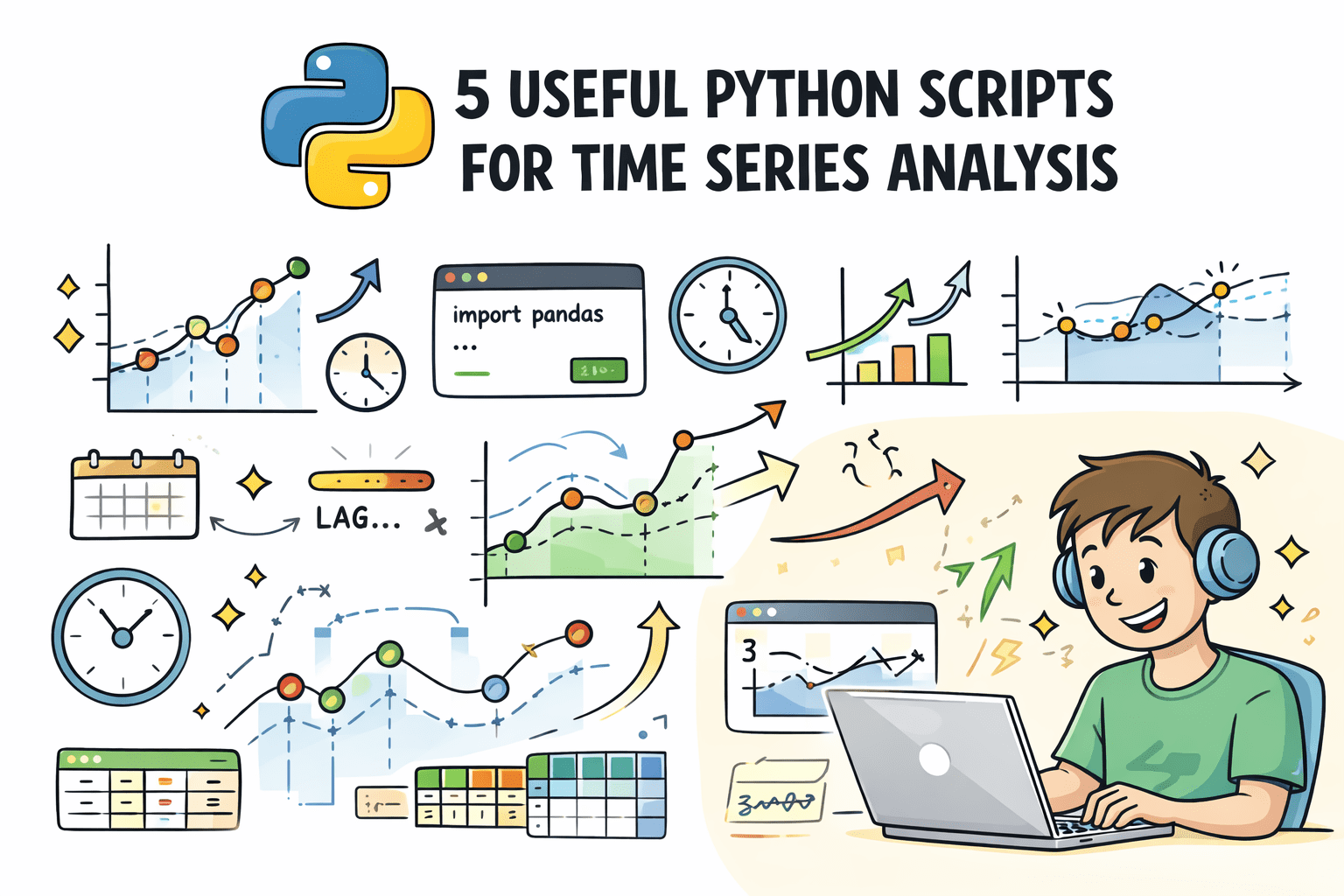
A collection of Python scripts addressing five foundational time series tasks has been released, each targeting a specific pain point in data preparation: resampling irregular data to uniform intervals, detecting anomalous spikes, and handling the common pathologies of real-world temporal data. The scripts accept standard CSV or Excel inputs, apply configurable processing logic, and produce annotated outputs—a straightforward design that deliberately avoids requiring deep Python expertise. This is notable not for any single technical innovation, but for how it frames a perennial problem in data work: the gap between what practitioners need to do and the effort required to do it competently at scale.
Time series analysis has become essential across industries—finance, IoT, e-commerce, supply chain, climate science—yet the work remains intensely manual. Raw temporal data arrives corrupted: timestamps jump irregularly, sensors dropout, duplicate readings appear, spikes contaminate averages. Before any analysis can begin, this noise must be cleaned, aligned, and flagged. In most organizations, this consumes the majority of data engineering and science time. Libraries like pandas exist and are powerful, but their flexibility demands expertise; applying the right resampling strategy, choosing between z-score and interquartile range anomaly detection, or correctly handling forward-fill versus interpolation requires domain judgment. The result is that teams either reinvent these solutions repeatedly or hire specialized engineers to build them once.
What this release exemplifies is the maturing trend of embedding domain knowledge into reusable, configuration-driven tools rather than making practitioners rebuild judgment each time. By encoding the *right* approach to each task—separate anomaly detection methods so different use cases can be tried without code changes, a gap report that shows exactly what was missing in the original data, rolling statistics that respect local trend context rather than forcing global assumptions—these scripts make competent time series preparation accessible to analysts who might otherwise defer to specialists. This pattern of abstraction is how nascent data work becomes routinized, and where it succeeds, it shifts the constraint from technical execution to strategic judgment: deciding *which* series to analyze, not *how* to prepare them.
The immediate beneficiaries are data teams in non-tech industries where time series analysis is necessary but specialized data engineering is a cost burden. A financial services analyst working with transaction logs, a supply chain planner managing demand forecasts, a climate researcher processing sensor arrays—all face identical data preparation problems but lack the dedicated tooling or in-house expertise larger tech companies take for granted. For these teams, these scripts lower the activation energy significantly. They also benefit smaller AI teams within tech, where context-switching between data prep and modeling is constant friction. Developers integrating time series forecasting into applications face similar bottlenecks, and having vetted reference implementations reduces iteration cycles.
The competitive shape here reflects how the Python data science ecosystem is consolidating. Pandas and scikit-learn remain dominant, but raw libraries are giving way to higher-level abstractions—AutoML, feature engineering pipelines, prompt-driven data tasks. Scripts like these sit between: too specialized to be in a general library, but too common to keep reimplementing. They suggest the future is less about mastering APIs and more about combining proven patterns. Organizations that standardize on such templates for data prep gain velocity; those that don't end up with fragmented implementations and repeated bugs. Over time, the scripts themselves may become absorbed into commercial tools or formalized as community standards.
What to monitor is whether this pattern expands and how it evolves. Will similar tools emerge for other data prep tasks—categorical encoding, feature scaling, handling missing values across different data types—creating a de facto standard toolkit? Will the community converge on configuration schemas for common tasks, lowering the friction of moving scripts between teams? And critically, as these tools proliferate, will they genuinely lower time-to-insight or simply shift the bottleneck: from data cleaning to configuration tuning, or from execution to interpretation of the cleaned data. The scripts themselves are competent and practical, but the real test is whether they catalyze the broader shift toward building analysis infrastructure as a product rather than as one-off engineering.
This article was originally published on KDNuggets. Read the full piece at the source.
Read full article on KDNuggets →DeepTrendLab curates AI news from 50+ sources. All original content and rights belong to KDNuggets. DeepTrendLab's analysis is independently written and does not represent the views of the original publisher.