AWS Machine Learning Blog
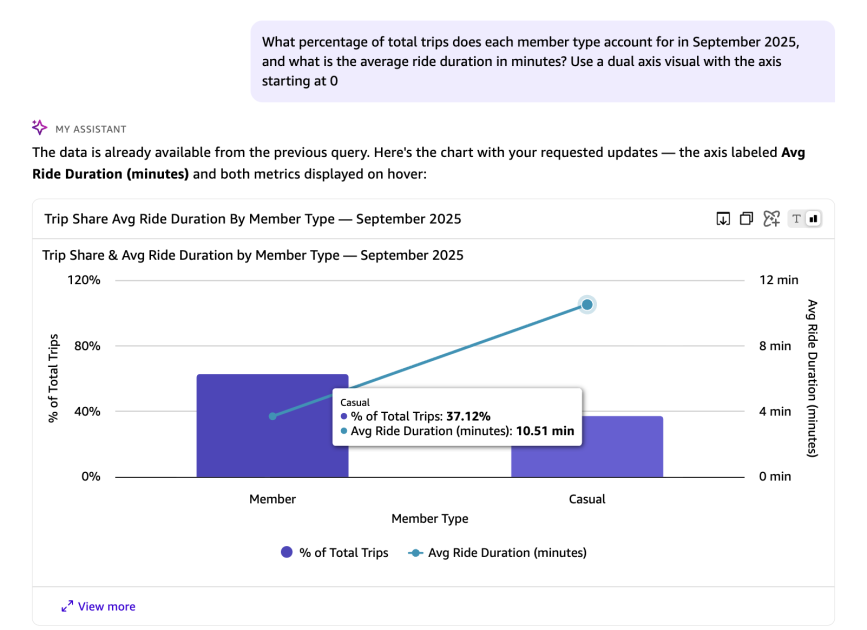
Amazon Quick just added a set of capabilities designed to collapse the time between a business question and a trustworthy answer from large enterprise datasets. The core addition is Dataset Q&A, which lets users ask natural language questions against databases containing millions of rows, and receive AI-generated SQL responses within seconds. Critically, the system doesn't sample or approximate—it queries the full dataset. Alongside this sits a reasoning-transparency layer that shows the SQL generation process, metadata lookups, and field mappings that informed the answer. AWS is also extending row-level and column-level security policies from its existing dashboard tools directly into the AI query layer, scoping results to user identity without additional configuration overhead.
This announcement lands at a specific moment of organizational friction. Enterprise analytics has long operated as a bottleneck: a business stakeholder wants to know "how is churn trending," but finding that answer requires either waiting for an available analyst to write and validate a query, or hoping a pre-built dashboard happens to exist for that exact question. The larger the organization, the worse this scales. More teams, more data domains, more questions nobody anticipated. Database metadata was already being used to constrain dashboard generation, but natural language query generation adds a layer of complexity—the system must infer semantics from column names, apply business definitions, resolve ambiguity (does "growth" mean customers, transactions, or revenue?), and do so while respecting governance rules that analysts painstakingly built.
The significance here isn't primarily technical; it's organizational. Quick's expansion democratizes a capability that previously required either a skilled analyst or a data engineer. By automating the translation from natural language to trustworthy query, AWS is shifting who can extract insights from enterprise data—from a bottlenecked specialist to anyone with a question. This has downstream effects on decision velocity, organizational hierarchy, and the economic value of analytics expertise itself. The inclusion of reasoning explanations is particularly telling: Amazon is acknowledging that speed without verifiability creates liability in regulated or high-stakes domains. A CFO needs to see the work, not just the answer.
The immediate beneficiaries are enterprise data teams operating at scale. Business users bypass the analyst queue and get answers in seconds. Data engineers and analysts themselves see their role reframed: rather than executing queries, they become metadata curators and governance architects—building and maintaining the semantic layer that makes AI-generated queries reliable. For enterprises still operating with manual, ticket-driven analytics, this is an onramp to a different operating model entirely. But this also creates new risk categories: confidence in AI-generated queries could erode institutional knowledge of data structure, and delegation without understanding can hide errors in semantic mapping.
In the broader analytics and AI landscape, this move consolidates AWS's position in a three-way competition. Snowflake is pushing in similar directions through partnerships and native AI features; Databricks has positioned itself as a lakehouse intelligence layer. Amazon's advantage is the depth of its ecosystem integration—Quick sits alongside Athena, Redshift, QuickSight, and IAM governance already in place at most large AWS customers. Extending security policies from dashboards to conversational queries, without forcing new configuration, is a significant friction reducer. The tradeoff is lock-in: once your metadata, security model, and query layer are native to AWS, migration costs rise sharply.
The questions worth tracking are less about what Amazon built and more about what happens at the edges of adoption. How does this system behave when asked deliberately ambiguous questions designed to probe its reasoning? What guardrails prevent over-confidence in AI-generated insights when the underlying data is dirty or schema inconsistencies exist? How quickly does the semantic layer become stale as business definitions evolve? And most critically: as more organizations outsource the translation from business question to data insight, who owns the accountability when the AI confidently answers a question in a way that's technically correct but strategically misleading? Amazon provides the tools for governance and transparency. The question is whether that's enough when the decision-maker never sees the analyst's skepticism.
This article was originally published on AWS Machine Learning Blog. Read the full piece at the source.
Read full article on AWS Machine Learning Blog →DeepTrendLab curates AI news from 50+ sources. All original content and rights belong to AWS Machine Learning Blog. DeepTrendLab's analysis is independently written and does not represent the views of the original publisher.