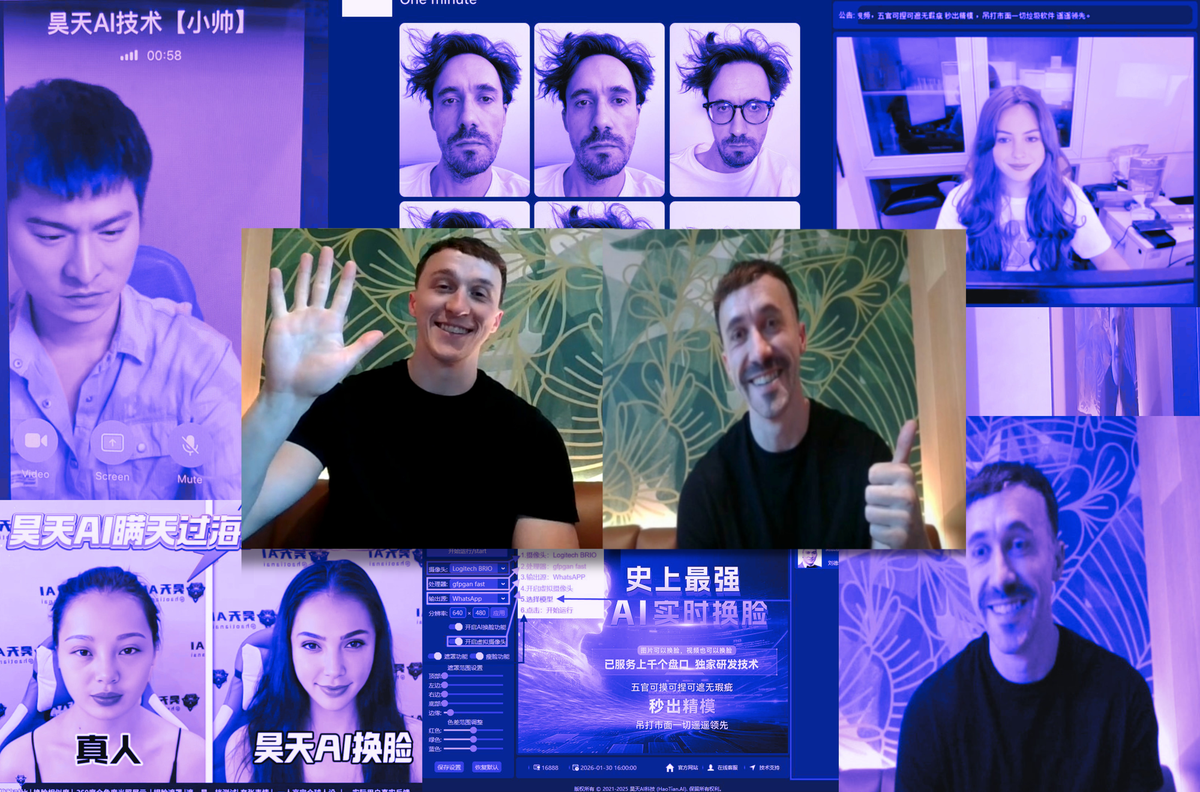
404 Media's investigation of "Haotian AI" exposes a particularly acute phase in the weaponization of synthetic media: realtime deepfake technology designed explicitly for fraud has moved from research papers and proof-of-concepts into active, commodified deployment. The software, reportedly popular among scammers operating internationally, performs live facial reenactment across mainstream communication platforms—WhatsApp, Zoom, Microsoft Teams—with sufficient fidelity that identity spoofing happens seamlessly. A journalist testing the tool experienced its effectiveness firsthand, watching their own biometric markers (facial hair, expressions, eye bags) convincingly replicated on an attacker's face in real-time. What distinguishes this from earlier deepfake concerns is the emphasis on *liveness* and *interactivity*: the software doesn't require pre-recorded video or offline processing. It operates in the moment, on commodity hardware, making identity verification through video call a rapidly obsolescing security control.
Deepfake technology has progressed through identifiable phases. Initial alarm centered on static portrait manipulation and pre-rendered videos (2017-2019), followed by concerns about detection evasion and synthetic speech. The research community invested heavily in both attack and defense capabilities. But the real acceleration happened as text-to-video models matured and real-time rendering techniques—borrowed heavily from gaming and graphics—began approaching broadcast quality. What we're seeing with Haotian AI is the commercial endpoint of that trajectory: sophisticated video synthesis no longer requires specialized hardware or expert knowledge. It's packaged, distributed, and actively monetized in underground markets. The tool exists because there is clear economic demand; fraud networks have already solved the business case and scaled the operation.
This matters because it collapses the distance between frontier AI capabilities and consumer-facing security vulnerabilities. Video calls have become the primary channel for high-touch fraud—whether romance scams, CEO impersonation, or account recovery. Financial institutions and platforms have largely treated video verification as a trust anchor, often the last defense when conventional 2FA fails. Haotian AI's emergence in the wild suggests that anchor is now compromised. The real impact isn't theoretical: victims will be defrauded at scale precisely because platforms and users still assume video calls carry inherent proof of identity. The software is priced accessibly, documented for non-technical users, and already distributed enough that 404 Media could obtain a copy. There's no indication that detection mechanisms built into Zoom, Teams, or WhatsApp are equipped to spot these synthetic feeds reliably.
The affected populations are immediate and broad. Consumers are the obvious targets—romance scams and impersonation attacks will accelerate, exploiting the psychology that video calls feel authentic. But the scope is wider: enterprises relying on video verification for access control, insurance claim validation, or account recovery are now exposed. Financial institutions and crypto platforms that use video-based KYC are vulnerable to coordinated synthetic identity fraud at scale. Law enforcement will face questions about video evidence authenticity. Less obviously, anyone whose face can be scraped from social media becomes a spoofing vector—the tool doesn't require consent or sophisticated source material. Platform developers building on video infrastructure (remote work tools, telehealth, digital notary services) are implicitly vulnerable until they implement liveness detection or cryptographic verification layers.
Competitively, this accelerates asymmetry between attack and defense. Prior deepfake concerns were largely academic or entertainment-focused; commercial incentives weren't strongly aligned with sophisticated synthesis. Fraud networks change the equation. Haotian AI's success suggests that whoever controls the deepfake toolchain—whether Chinese vendors, local resellers, or platform integrators—has commercial scale on their side. Legitimate players (Zoom, Microsoft, WhatsApp, Apple) will respond with liveness detection and biometric authentication, but they're reactive. The vendors of synthetic media tools operate in spaces with minimal regulatory friction and can iterate quickly. This is a replay of earlier asymmetries: malware always outpaces antivirus; deepfakes may outpace detection indefinitely, not because detection is impossible, but because the incentive structures favor the attackers.
What comes next will define whether video remains viable as an authentication mechanism. The immediate question is detection: can platforms reliably spot Haotian AI and similar tools on live calls? Longer-term, the answer likely involves shifting video verification toward cryptographic proof rather than biometric authenticity—hardware attestation, signed video streams, or decentralized identity mechanisms that don't rely on facial recognition alone. Until then, assume any high-stakes transaction conducted over video is vulnerable. The scam economy has moved from stolen credentials and social engineering into synthetic identity synthesis. The technology has matured faster than defenses. That gap will be expensive to close.
This article was originally published on 404 Media. Read the full piece at the source.
Read full article on 404 Media →DeepTrendLab curates AI news from 50+ sources. All original content and rights belong to 404 Media. DeepTrendLab's analysis is independently written and does not represent the views of the original publisher.