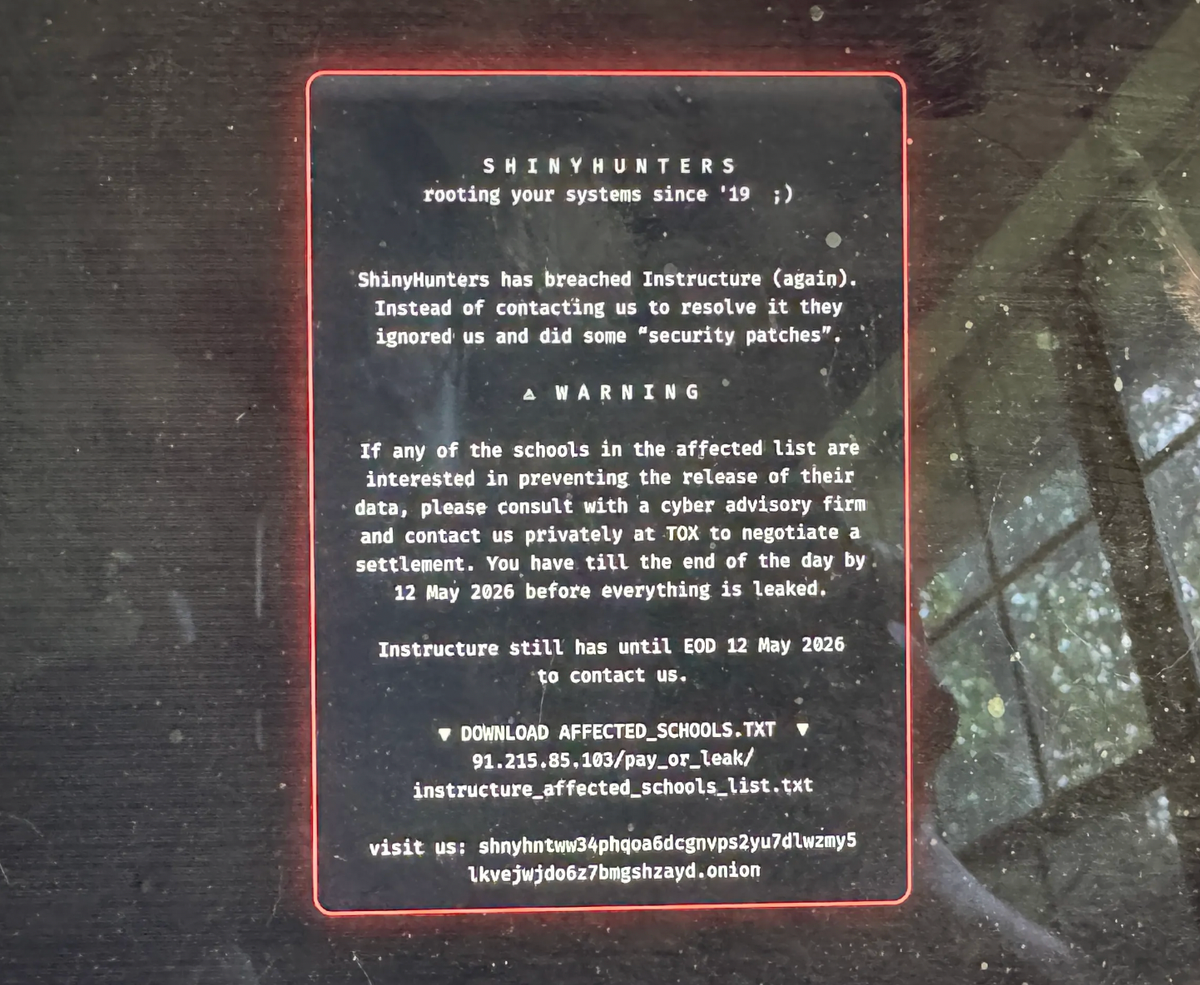

Canvas, the learning management platform used by 8,800 schools worldwide, fell victim to a coordinated ransomware attack during the most critical week of the academic calendar. ShinyHunters, a loose-knit collective operating across dark web marketplaces, claims to have exfiltrated data on 275 million users and subsequently deployed login-page ransom notes demanding negotiation directly with individual institutions. The timing proved devastating—students across major universities including the University of Illinois and UC system found their exam access blocked or severely restricted during finals week, forcing mass rescheduling and extension of deadlines. Instructure, Canvas's parent company, disclosed the breach publicly, but the damage to institutional trust and operational continuity had already crystallized in real time.
This breach didn't emerge from nowhere. Canvas represents a broader institutional shift toward centralized, cloud-based education infrastructure—a vulnerability that's been accelerating for over a decade. The education sector has traditionally lagged in security maturity compared to finance or healthcare, yet it has become increasingly attractive to ransomware operators precisely because schools lack the security resources of enterprise tech companies and because educational disruption generates immediate, visible pressure on decision-makers. ShinyHunters itself has evolved from a casual credential-stealing collective into a sophisticated ransomware operation, demonstrating capability across multiple attack vectors after its 2024 Snowflake breach enabled follow-on compromises at TicketMaster and other high-profile targets. The group's ability to pivot from one vertical to another signals a mature threat ecosystem that treats education as viable terrain.
For the AI industry, this matters because the education sector is simultaneously becoming a major deployment vector for artificial intelligence. Learning platforms increasingly integrate AI for personalized instruction, automated grading, proctoring, and administrative optimization—features that make these platforms more valuable and more attractive as operational targets. A compromised Canvas instance or breached student data doesn't just disrupt exams; it undermines institutional confidence in adopting the very AI-enabled tools that vendors promise will improve educational outcomes. The breach creates a trust deficit that extends beyond Canvas itself to the entire category of cloud-based educational software, precisely at the moment when generative AI is being touted as a transformative force in K-12 and higher education. Schools that were contemplating AI tutoring systems or automated assessment tools now face pressure to prioritize security posture over feature adoption.
The immediate human toll falls on students, faculty, and administrators caught mid-semester with inaccessible coursework and compromised exam schedules. But the institutional victims extend to every school forced to negotiate or decide whether to pay ransom, invest in emergency containment, or accept operational chaos. For smaller institutions with limited IT budgets, the breach creates an asymmetric problem: they lack the infrastructure to absorb operational disruption or the negotiating power to challenge ransom demands, yet they're equally exposed as larger universities. Faculty members managing hundreds of student records and assessment deadlines suddenly became unwilling proxies in a negotiation between criminals and a vendor. The attack weaponizes the platform's centrality—the very factor that made it attractive for efficiency gains now becomes a single point of failure affecting millions simultaneously.
Canvas's market dominance (commanding roughly half the LMS market in higher education) makes it strategically valuable as a target in ways that more fragmented competitors are not. A successful attack on Canvas creates cascading pressure across the entire sector because switching costs are high and alternative platforms must now absorb capacity spikes from schools seeking rapid migration. Smaller LMS competitors like Brightspace and Blackboard suddenly gain negotiating leverage with security-conscious institutions, and open-source alternatives like Moodle experience renewed interest from schools wanting to avoid vendor lock-in risks. The attack also highlights why ed-tech vendors have become consolidated—a distributed ecosystem of school-hosted systems would be harder to ransom at scale, but it would also be costlier to maintain. Canvas's efficiency gains are also its liability.
What comes next will determine whether this breach catalyzes meaningful security investment in the education sector or becomes another forgotten crisis. Watch whether institutions demand penetration testing or security audits before renewing licenses, whether Instructure invests substantially in breach notification improvements and incident response transparency, and whether regulatory pressure emerges to establish minimum security standards for platforms serving minors and sensitive student data. The broader question is whether education will follow healthcare's post-breach adoption of compliance frameworks or remain a soft target. Critically, monitor whether this incident slows AI adoption in schools—if institutions become more risk-averse rather than security-forward, the timeline for AI-enabled learning tools may shift by years, reshaping the competitive dynamics across the edtech AI space.
This article was originally published on Ars Technica. Read the full piece at the source.
Read full article on Ars Technica →DeepTrendLab curates AI news from 50+ sources. All original content and rights belong to Ars Technica. DeepTrendLab's analysis is independently written and does not represent the views of the original publisher.