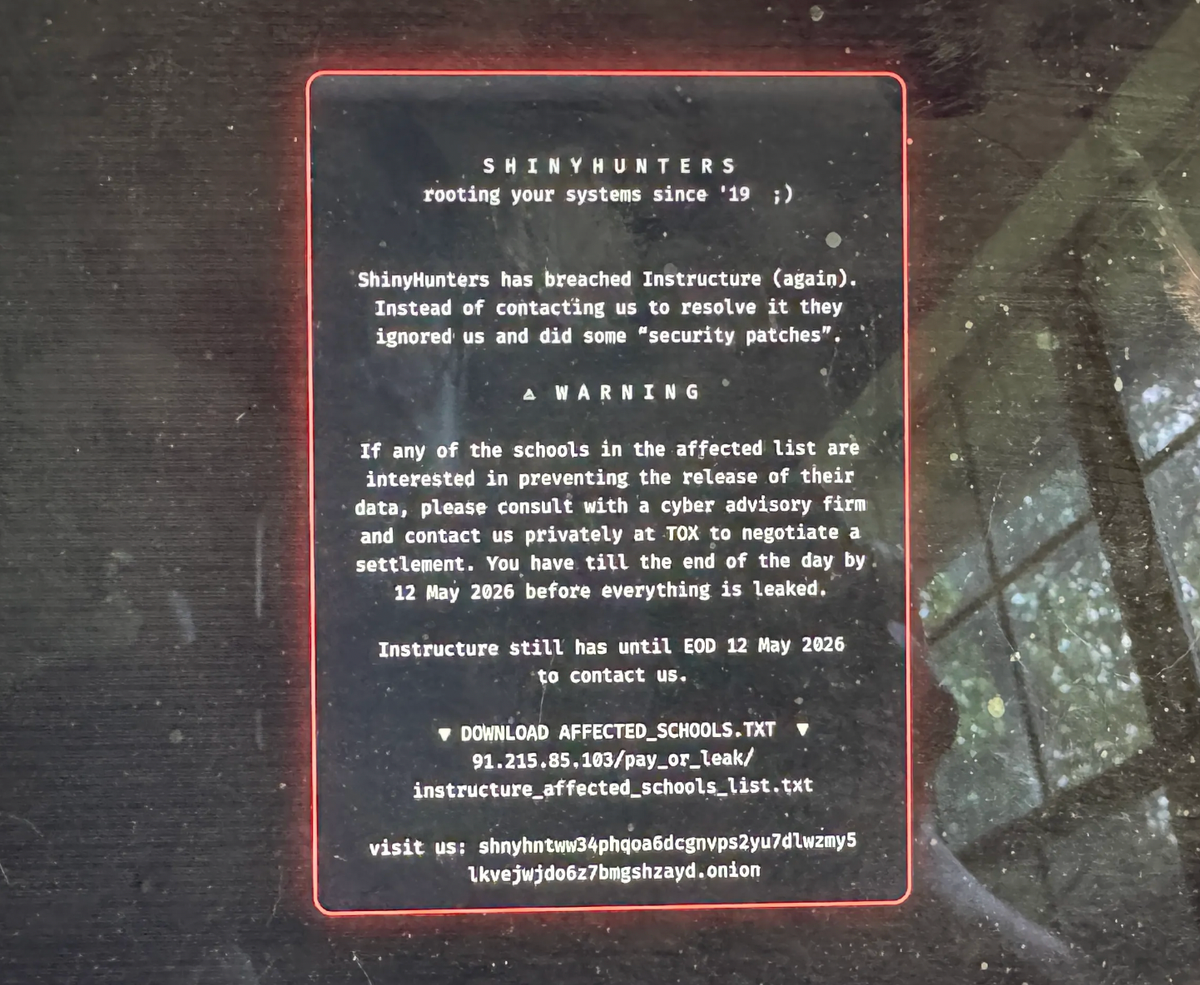
Instructure's Canvas suffered a significant breach when ShinyHunters, a ransomware group, compromised the company's systems and claimed access to data affecting over 275 million individuals across thousands of universities and K-12 schools. The stolen information includes names, email addresses, student identification numbers, and archived messages between students and instructors. The breach occurred at least twice—first on April 29, then again Thursday—suggesting either unpatched vulnerabilities or dormant access that went undetected for days. Canvas was restored Thursday evening, though the company hasn't clarified whether it paid ransom or recovered through incident response alone. The immediate impact was operational chaos: institutions cancelled classes, locked students out of course materials and grading, and administrators scrambled to assess what data was exposed and how.
Canvas's dominance didn't result from superior design but from market consolidation. What began as a specialized learning management system evolved into the de facto system of record—a single platform where instruction, assessment, and interpersonal communication converge. Universities adopted Canvas through network effects and high switching costs: once courses, grades, and communication archives accumulated within the platform, migrating to competitors became prohibitively expensive. Instructure's market power grew steadily while competition narrowed. Blackboard exists but carries a legacy perception; smaller competitors serve niches rather than challenging Canvas's market position. The industry never developed the regulatory oversight or operational redundancy typical of other mission-critical infrastructure. Education institutions treated Canvas as essential but lacked the governance frameworks necessary to manage that criticality.
The Canvas breach exposes a structural vulnerability in how institutions handle mission-critical systems. Energy grids, telecommunications networks, and financial systems developed regulatory requirements and built-in redundancy specifically because they became too important to fail. Ed-tech platforms escaped this scrutiny despite assuming nearly identical roles. Students, faculty, and administrators treat Canvas as the system of record for academic progress and institutional accountability. A breach at this scale—affecting both minors and their educational records—represents a failure not just of one company's security but of an entire sector that outsourced critical functions without demanding appropriate governance. The stolen data includes behavioral patterns and interpersonal communications that could enable future social engineering, identity theft, or harassment campaigns.
The impact cascades across constituencies. Students, particularly minors in K-12 systems, face privacy violations at formative moments. Educators' professional boundaries are compromised through exposed student-teacher conversations. Institutions face immediate costs—incident response, notifications, and litigation—but longer-term reputational damage may prove costlier. Universities spent the pandemic building trust in remote learning; compromising that infrastructure erodes confidence at a moment when online education is becoming permanent. K-12 schools face heightened regulatory exposure for failing to protect minors' data, particularly under emerging state privacy laws and emerging federal child-protection frameworks.
This incident will reshape ed-tech's competitive landscape. Institutions will explore alternatives that reduce vendor dependency—decentralized approaches, best-of-breed tools, or even open-source solutions like Moodle that previously seemed inferior but now appear safer. Canvas's market dominance, built on comprehensiveness, has become a liability; alternatives can position themselves as lower-risk. Instructure will face demands for better security transparency, granular access controls, and federated identity options that reduce data concentration. The breach proves that market consolidation in ed-tech was never stable; when trust breaks, institutional inertia can reverse quickly.
Watch regulatory response carefully. State attorneys general will likely investigate whether Instructure met its duty of care protecting student data, potentially triggering new ed-tech-specific regulations or renewed enforcement of FERPA and state privacy laws. The critical test arrives in coming months: do schools actually migrate, or does inertia preserve Canvas's dominance? Monitor whether this becomes an inflection point for how institutions evaluate critical systems—whether it forces deliberate fragmentation of ed-tech stacks to eliminate single points of failure. If institutions begin designing for distributed risk rather than consolidated convenience, the entire market structure could shift.
This article was originally published on 404 Media. Read the full piece at the source.
Read full article on 404 Media →DeepTrendLab curates AI news from 50+ sources. All original content and rights belong to 404 Media. DeepTrendLab's analysis is independently written and does not represent the views of the original publisher.