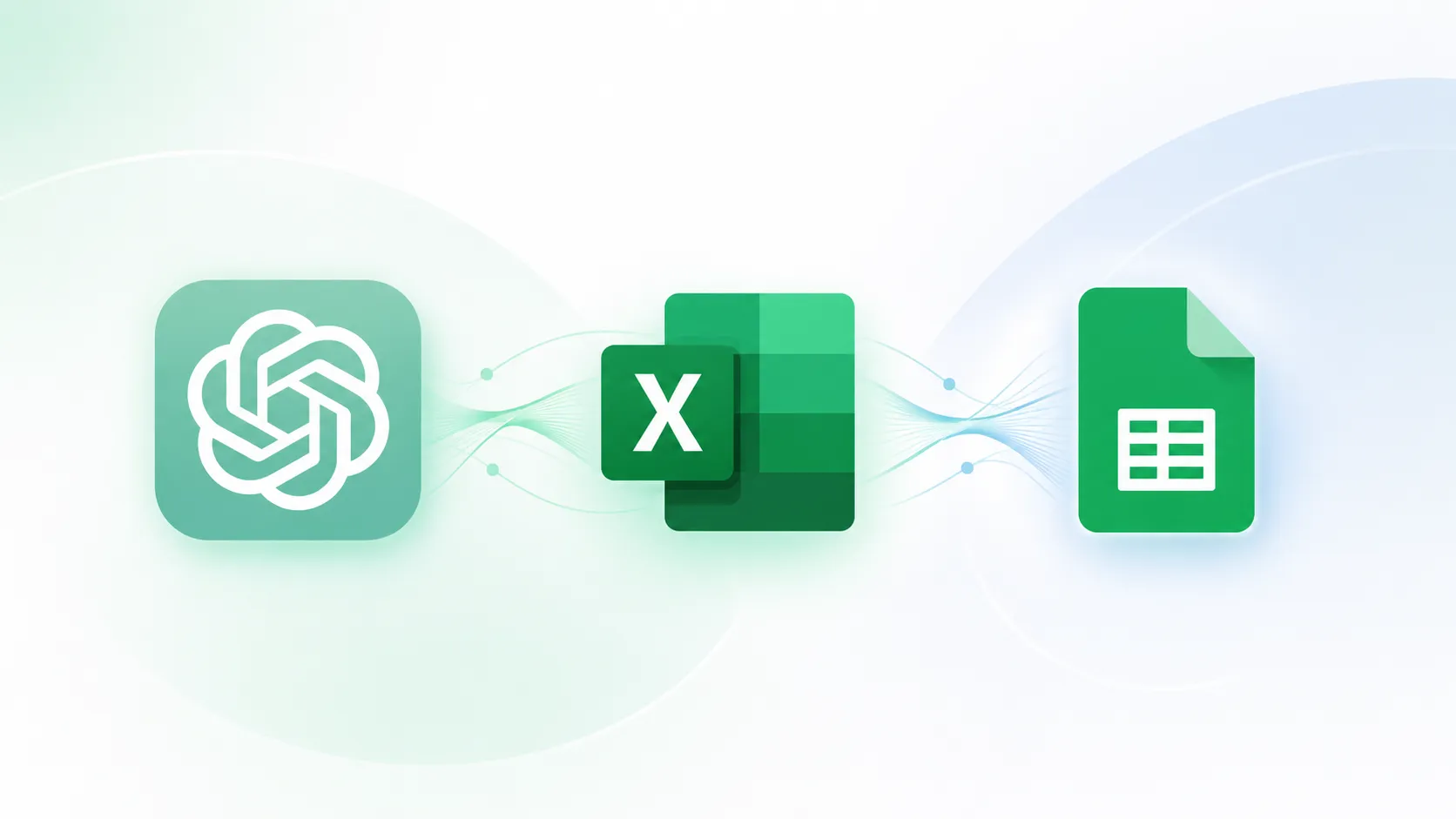
OpenAI has quietly executed one of its most consequential distribution moves of the year by embedding ChatGPT directly inside Microsoft Excel and Google Sheets as a native add-in powered by GPT-5.5. Rather than requiring users to bounce between a chat window and their spreadsheet — copying data, pasting outputs, and reformatting in between — the new plugin lives inside the application itself, accessible through a sidebar that can generate datasets, construct entire workbooks, and manipulate cells in place. Availability is unusually broad: every paid tier from Business and Enterprise down to Edu and K-12 gets it, but so do Free and Go users, which signals that OpenAI is treating this less as a premium feature and more as a beachhead.
The context here is critical. For nearly two years, OpenAI's spreadsheet story was effectively outsourced to Microsoft, which bundled GPT-4-class reasoning into Copilot for Microsoft 365 at a $30-per-seat premium. That arrangement made Microsoft the gatekeeper of ChatGPT inside the world's most-used productivity surface, and it left Google Sheets — a market OpenAI had no clean path into — entirely uncovered. The launch of a first-party OpenAI add-in that runs inside both suites, on the free tier no less, marks a deliberate decoupling. OpenAI is no longer content to be the model layer beneath someone else's UX; it wants the user relationship inside the spreadsheet itself.
The strategic significance is larger than the feature description suggests. Spreadsheets are where most knowledge work that involves numbers actually happens, and they remain the single most defensible moat in enterprise software. Whoever owns the AI assistant inside the cell — not adjacent to it — owns the workflow. By shipping a sidebar that can be installed in one click and used without leaving the grid, OpenAI is positioning ChatGPT as a horizontal layer that sits above both Microsoft and Google's own AI offerings. It is, in effect, an attempt to commoditize the host application and elevate the model brand, much the way Grammarly once did to word processors.
For end users, the practical impact is immediate and most pronounced for the long tail of analysts, small-business operators, students, and finance staff who never had Copilot budget and who have spent the last eighteen months screenshotting tables into chat windows. Developers and ISVs should read this differently — it is a warning shot that OpenAI intends to ship destination-grade integrations itself rather than rely on third-party plugin ecosystems, which has implications for anyone building GPT-powered spreadsheet tools on the side. Enterprises with active Copilot rollouts now face an awkward overlap question: two AI sidebars, two billing relationships, two governance surfaces, and employees who will gravitate to whichever one feels less restricted.
Competitively, the move squeezes Microsoft from an unexpected angle. Copilot's value proposition has always rested partly on the assumption that deep Office integration was something only Microsoft could deliver. An OpenAI-branded sidebar inside Excel — built on the same underlying partnership — undercuts that narrative and gives customers a reason to question what they are actually paying the Copilot premium for. Google, for its part, gets a free upgrade to Sheets at the cost of watching Gemini get bypassed on its own surface, which is a harder problem because Google cannot retaliate by pulling ChatGPT from Microsoft's store. Anthropic and the other model labs, meanwhile, are now visibly behind on distribution into the productivity layer where most enterprise AI value will be measured.
The questions worth watching are about depth and durability. A sidebar that generates sample datasets is a demo; a sidebar that can audit a 40-tab financial model, respect named ranges, and write back formulas without breaking dependencies is a product, and we do not yet know which of those GPT-5.5 actually delivers in practice. Watch for how Microsoft responds — whether through store policy, Copilot repricing, or quiet API friction — and whether OpenAI extends the same pattern into Word, PowerPoint, and Google Docs. If it does, the era of AI-as-a-chat-app is effectively over, and the era of the model vendor as a parallel productivity suite has begun.
This article was originally published on Analytics Vidhya. Read the full piece at the source.
Read full article on Analytics Vidhya →DeepTrendLab curates AI news from 50+ sources. All original content and rights belong to Analytics Vidhya. DeepTrendLab's analysis is independently written and does not represent the views of the original publisher.