Towards AI
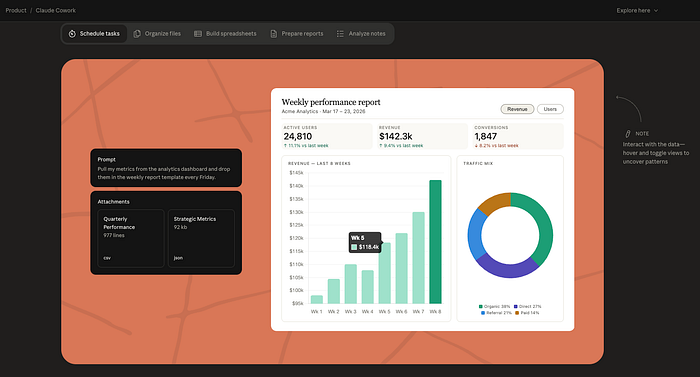
Anthropic has released Claude Cowork, a desktop application that positions itself as the bridge between conversational AI and autonomous agents. Unlike Claude Chat's simple prompt-response model or Claude Code's terminal-centric workflow, Cowork introduces a graphical interface designed for non-technical users to orchestrate multi-step, file-aware tasks with minimal friction. The platform connects to external services—Gmail, Slack, Salesforce—and critically, it can execute recurring workflows on a schedule, a capability absent from standard chatbots. This represents a significant product evolution: moving Claude from a tool you consult into a tool that performs work independently on your behalf.
The timing reflects a clear industry inflection. Over the past eighteen months, the limitations of chat-based AI have become apparent: they excel at synthesis and analysis but struggle with sustained task execution across disparate systems. Meanwhile, the success of autonomous agent frameworks and AI-native workflow tools has demonstrated market appetite for this kind of integration. Anthropic's approach differs from broader no-code automation platforms by centering the reasoning capability—the agent doesn't execute rigid conditional logic, but interprets intent and adapts to unexpected situations. This builds on Anthropic's existing strength in instruction-following and multi-step planning, capabilities the company has refined through Claude Code's adoption among developers.
For the enterprise, this shift is consequential. Cowork outsources cognitive work that currently consumes thousands of hours across operations, marketing, and legal—report generation, document triage, data synthesis, stakeholder communication. The platform's role-specific plugins (finance, legal, operations) suggest Anthropic is packaging domain logic into the product itself, which accelerates time-to-value and reduces customization friction. The security model—projects as isolation boundaries with folder-level access control—acknowledges enterprise concerns about data leakage and context bleed. This is production-grade thinking, not an afterthought. By integrating scheduled execution directly, Anthropic avoids a critical gap that has plagued competing frameworks: users can now define a workflow once and forget it, rather than managing external schedulers or cron jobs.
The constituency for Cowork is deliberately broad but hierarchical. Non-technical knowledge workers become the primary users—the business analyst, the legal reviewer, the marketer coordinating campaigns. Developers and IT teams become operators and customizers rather than end-users, responsible for crafting skills and managing plugin permissions. This inverts the usual power dynamic of developer-first tools and signals that Anthropic is serious about capturing workflow automation budgets that have traditionally belonged to Zapier, Make, and Salesforce. Enterprises with heterogeneous system stacks see immediate value; SMBs with simpler infrastructure may find it unnecessary overhead.
Cowork enters a crowded competitive landscape, but with a distinct advantage: it inherits Claude's reasoning prowess, which remains ahead of most competitor models in multi-step planning and instruction interpretation. OpenAI has Operator in private preview, but lacks Cowork's scheduled execution and integrated connectors. Specialized RPA vendors offer deeper integrations but lack Claude's language understanding. The real competitive threat is not a single product but an ecosystem—if users begin orchestrating work through Zapier or n8n with simpler Claude API calls, Anthropic risks becoming a backbone rather than a platform. Cowork attempts to prevent that by bundling connectors and execution environment, creating switching costs and lock-in.
The near-term questions center on execution and adoption friction. Cowork's success depends on the quality of its plugin library, the accuracy of its scheduled task execution, and whether real-world workflows can be expressed intuitively through its interface. The reliance on user desktop machines for scheduled task execution—skipping runs when the machine sleeps—introduces reliability trade-offs that enterprises may find unacceptable. Longer-term, watch whether Anthropic extends Cowork to cloud-based scheduling and whether competitors respond with comparable reasoning-first orchestration. The deeper question: does AI-driven task automation actually eliminate work, or does it shift from execution to specification and oversight? If the latter, Anthropic has merely moved the bottleneck upstream.
This article was originally published on Towards AI. Read the full piece at the source.
Read full article on Towards AI →DeepTrendLab curates AI news from 50+ sources. All original content and rights belong to Towards AI. DeepTrendLab's analysis is independently written and does not represent the views of the original publisher.