Towards Data Science
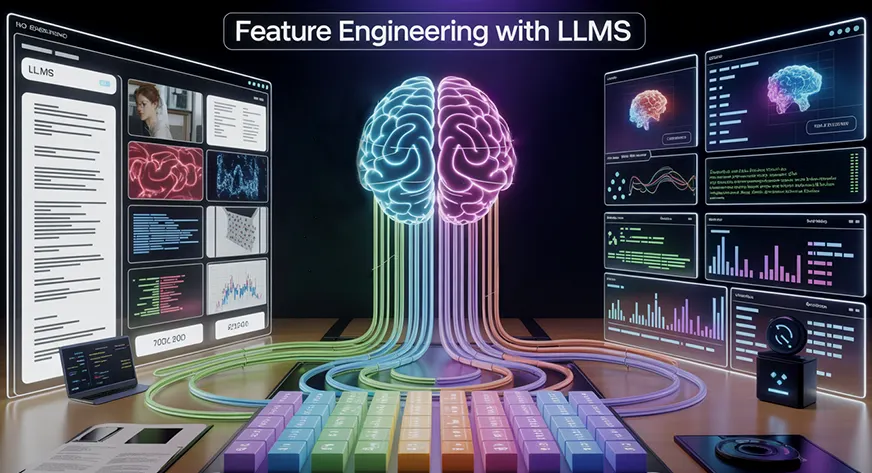
The convergence of LLMs with classical feature engineering represents a fundamental shift in how practitioners prepare data for downstream machine learning tasks. Rather than treating language models as mere inference engines, this approach weaponizes their semantic understanding to automatically distill meaningful representations from raw, unstructured data—text logs, user interactions, free-form feedback—that traditional methods like TF-IDF or one-hot encoding butcher through oversimplification. The practical implication is straightforward: engineers can bypass months of manual signal discovery by leveraging pretrained models that already encode linguistic nuance, contextual awareness, and world knowledge accumulated from internet-scale training data. This doesn't eliminate feature engineering; it industrializes it.
What makes this significant is the democratization angle. Feature engineering has historically been a bottleneck controlled by domain experts who could afford months of experimentation to surface non-obvious patterns. By automating semantic feature extraction, organizations can now deploy competitive ML systems faster and with smaller specialized teams. However, this creates a new class of technical debt: LLM-based features introduce opaquity, computational overhead, and latency considerations that classical features never demanded. The dependency on particular model architectures also risks cascading failures if foundation models shift or deprecate. The narrative here isn't "LLMs solved feature engineering"—it's "LLMs traded one set of constraints for another."
Watch for three developments: whether organizations systematize feature stability across model updates, how production systems handle the inference cost of generating features at scale, and whether the promised semantic richness actually translates to measurable performance gains in real-world deployments beyond academic benchmarks. The gap between newsletter tutorials and production reliability often consumes years. DeepTrendLab readers should expect substantial refinement in this space before LLM-powered feature engineering becomes standard practice outside ML-heavy organizations.
This article was originally published on Analytics Vidhya. Read the full piece at the source.
Read full article on Analytics Vidhya →DeepTrendLab curates AI news from 50+ sources. All original content and rights belong to Analytics Vidhya. DeepTrendLab's analysis is independently written and does not represent the views of the original publisher.