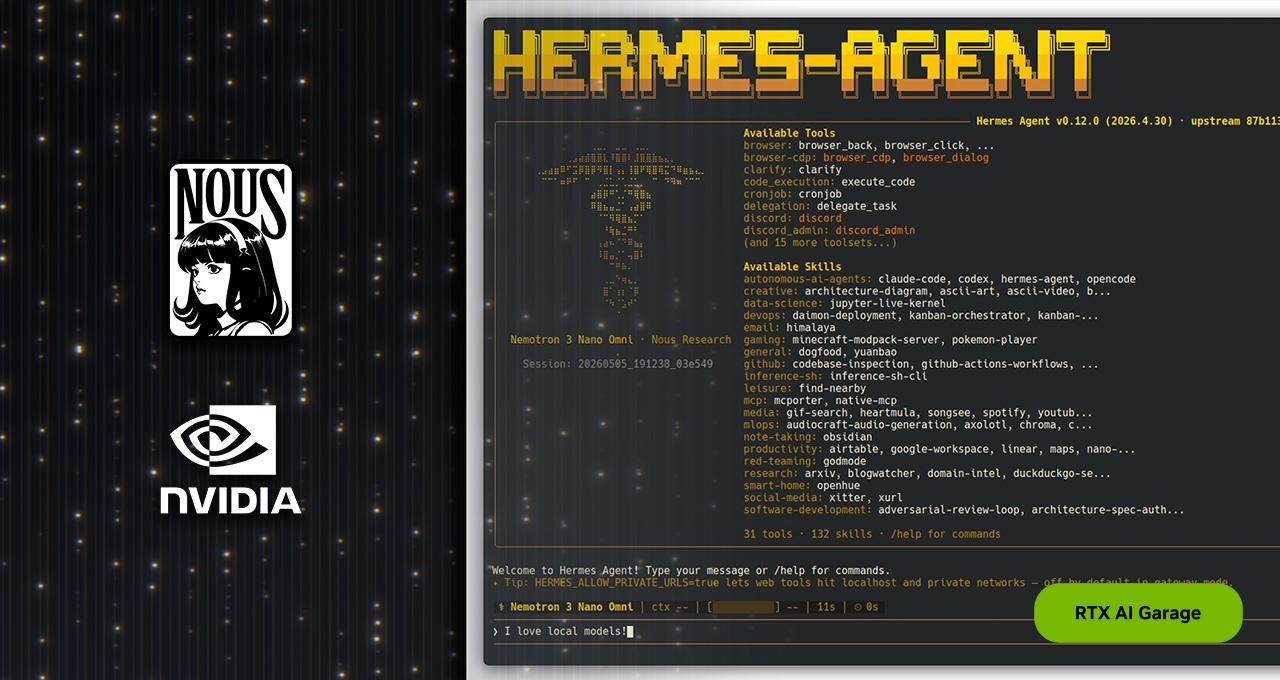
Hermes, an open-source agent framework from Nous Research, has crossed 140,000 GitHub stars in three months and now claims the title of most-used agent on OpenRouter—a remarkable milestone that signals a major shift in how developers are choosing to build autonomous AI systems. The framework's success reflects a broader architectural advantage: Hermes combines self-improving capabilities, sub-agent decomposition, and curated reliability through stress-tested skills and plugins, positioning it as a production-ready alternative to quickly-assembled competitors. Accompanying this are Alibaba's Qwen 3.6 models, dense LLMs that deliver datacenter-class performance on modest local hardware—the 35B variant matching 120B predecessors while consuming one-third the memory. Together, these announcements represent a maturation threshold: agentic AI is no longer theoretical or experimental, but deployable today on commodity hardware.
The convergence of Hermes and Qwen 3.6 didn't emerge in isolation. The market for open-source agentic frameworks has accelerated dramatically over the past eighteen months, following the initial proof-of-concept phase that demonstrated LLM agents could self-correct and coordinate multiple tools. OpenAI's and Anthropic's agent ecosystems remain tightly coupled to their cloud APIs and inference costs; the emergence of reliable local agents directly challenges this model. Simultaneously, efficiency breakthroughs in model architecture have compressed the parameter-to-performance gap, making local inference economically viable for many workloads. NVIDIA's consumer and enterprise GPU line has matured to handle continuous agent operation, and frameworks have evolved from prototype scaffolding into deliberate orchestration layers. This timing is no accident—hardware capability, model efficiency, and open-source momentum have converged.
The implications ripple across multiple dimensions. First, local agentic AI democratizes continuous automation: small teams and individual developers can now deploy always-on agents without engineering teams dedicated to infrastructure or API cost management. Second, data sensitivity and compliance constraints that previously mandated expensive on-premise solutions become less critical business drivers—organizations can now run sensitive workflows on local models without compromising performance. Third, the distinction between "inference model" and "agent framework" is collapsing; the agent becomes the unit of deployment and composition, not the model. This shifts strategic thinking from model selection (which weights to use?) to framework architecture (how do agents decompose tasks, learn, and persist knowledge?). Fourth, the decoupling of agent capability from proprietary cloud inference creates genuine economic competition at the application layer rather than at the API level.
The immediate beneficiaries are enterprise developers and platform teams facing pressure to reduce LLM API costs without sacrificing capability. Engineering teams at companies processing high volumes of routine decision-making—customer support automation, content moderation, data extraction, compliance review—can now evaluate Hermes as a cost-competitive path that avoids repeated API calls and vendor lock-in. Researchers studying agent behavior gain a fully open system with curated tooling, lowering the barrier to understanding and improving agentic patterns. Consumer software developers building personal assistant experiences gain a framework designed explicitly for persistent, local operation. However, the largest near-term beneficiary is NVIDIA, whose RTX and DGX Spark lines become the de facto standard for local agent deployment, effectively capturing a new infrastructure market segment that was previously either cloud-dependent or niche.
The competitive landscape is reshuffling. OpenAI, Anthropic, and Google have built their agent strategies around API consumption and hosted inference—architectural decisions that now face headwinds as Hermes demonstrates that frameworks matter more than model size. This doesn't eliminate their advantage in raw model capability or training data quality, but it narrows the moat considerably. Open-weight model providers like Alibaba gain leverage by optimizing for local efficiency over cloud scale. The real tension is whether API-first architectures will adapt by offering lighter-weight on-device inference options or whether they'll double down on cloud integration as their differentiator. Nous Research's explicit focus on reliability—curating and stress-testing every skill—also raises the bar for what "open-source agent framework" means, moving away from permissive-but-fragile collection of tools toward opinionated, production-grade systems.
What demands watching is whether this local momentum sustains beyond the early-adopter phase. Hermes' self-improving capability remains largely aspirational—the mechanisms for skill learning and refinement are present, but real-world examples of agents that genuinely improve over time in complex domains remain limited. Memory and context management for long-running local agents also presents unsolved scaling challenges; Hermes' sub-agent design mitigates this, but the approaches are still untested at enterprise scale. Additionally, the hardware requirement—continuous GPU access, reliable power, network connectivity for tool integration—isn't frictionless, and organizational IT departments may resist local deployment patterns. Finally, the question of whether Hermes maintains its velocity as a volunteer-driven open-source project or requires institutional backing remains open. If it falters, the window for competitors to establish alternative local-first agent frameworks remains briefly open.
This article was originally published on NVIDIA AI Blog. Read the full piece at the source.
Read full article on NVIDIA AI Blog →DeepTrendLab curates AI news from 50+ sources. All original content and rights belong to NVIDIA AI Blog. DeepTrendLab's analysis is independently written and does not represent the views of the original publisher.