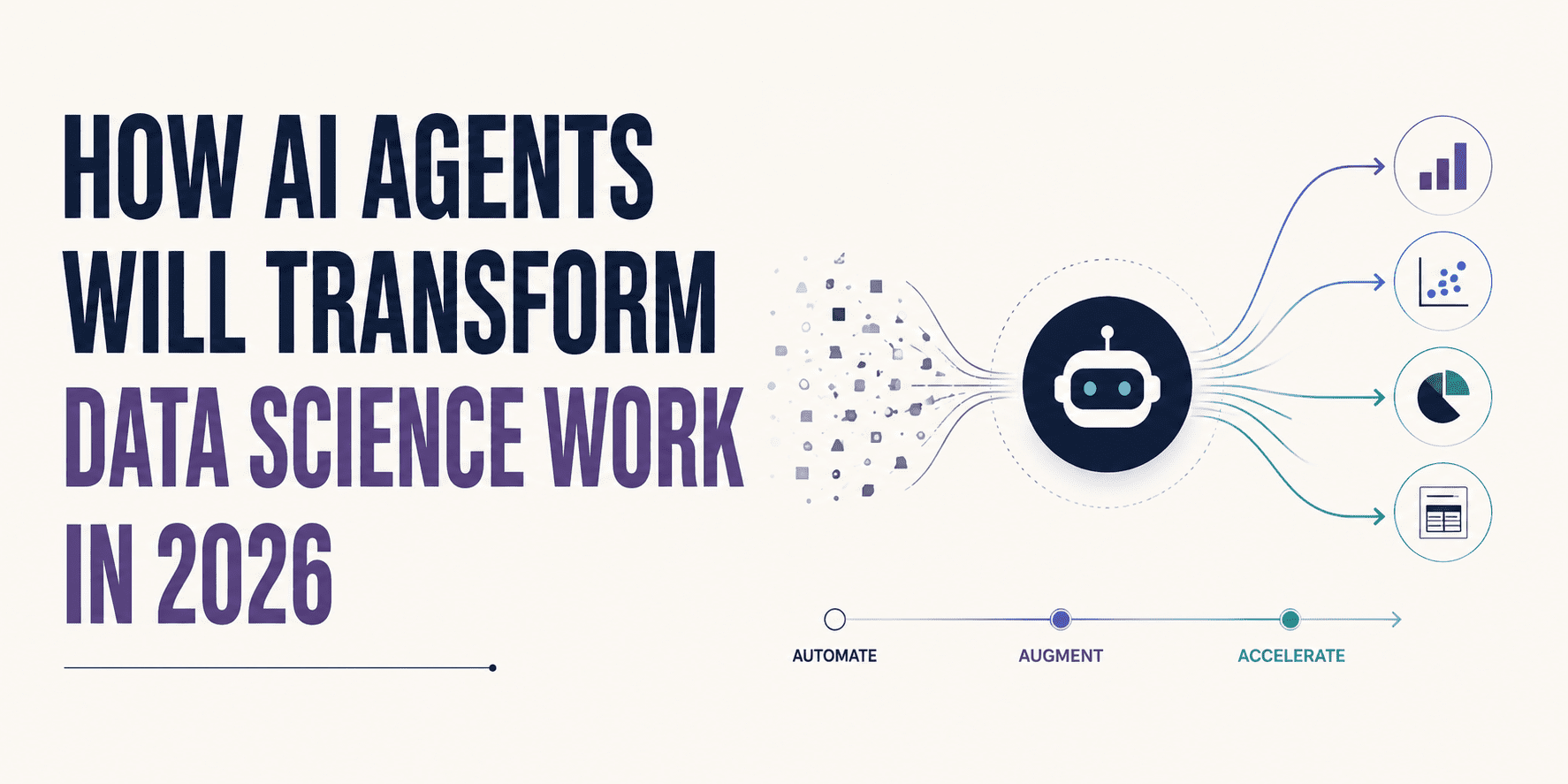
The data science community is converging on a seemingly settled question: autonomous AI agents will become the standard toolkit for practitioners in 2026, automating the scaffolding work that currently consumes the majority of project cycles. The distinction being drawn is between passive AI systems—large language models that respond to queries—and proactive agents that can decompose objectives, iterate on solutions, and report back with findings. This framing arrives at a moment when data teams are drowning in legitimate grunt work: imputing missing values, engineering features, systematically testing model variants, orchestrating training pipelines. The proposition is straightforward—agents handle the mechanical parts, freeing practitioners to focus on the strategic questions that still require human judgment, intuition, and business acumen.
This narrative echoes a recurring pattern in technical work. Database optimization shifted from manual index tuning to query planners. Compilers eliminated hand-written assembly. Version control democratized code collaboration. In each case, the enabling innovation automated the lowest-level, most repetitive layer of technical work, which forced a corresponding elevation of human expertise. Data science arrived late to this cycle. The field still operates with workflows that feel closer to the 1980s than the 2020s—practitioners manually scripting data transformations, running sequential experiments, cherry-picking results. The gap between what modern AI can theoretically accomplish and what it actually does in real pipelines has created a vacuum. Agents promise to close that gap by introducing continuous execution and feedback loops rather than point-in-time interactions.
What's genuinely significant here isn't the technology itself, but the acknowledgment of where value actually resides. The implicit admission is that writing Python to clean data or testing random forest against gradient boosting isn't what separates senior practitioners from junior ones. The skill premium should accrue to people who can interpret why a model behaves a certain way, recognize which business assumptions are baked into a problem framing, and push back when a metric doesn't reflect what's actually being optimized. If agents genuinely absorb the mechanical work, companies that adopt them will experience productivity jumps comparable to spreadsheets or cloud infrastructure. But more interestingly, they'll expose which practitioners were actually adding intellectual value and which were just competent at task execution. This reckoning will reshape both job markets and compensation structures.
The impact will stratify sharply across organizational contexts. Mature data teams at companies with sophisticated infrastructure will gain the most from agent-driven workflows—they have well-defined problems, clean datasets, and infrastructure to iterate against. Conversely, teams operating with messy real-world data, shifting business requirements, and underdeveloped data infrastructure will find agents less transformative. Agents can't negotiate ambiguous problem statements or navigate organizational politics. They also can't substitute for practitioners who understand the domain deeply enough to recognize when the data is lying. For individual data scientists, the intermediate implication is clear: execution skills have a shorter half-life than interpretive judgment. Education programs that emphasize "learning Python and scikit-learn" will train people for jobs that partially disappear. Those that emphasize statistical thinking and business problem decomposition will remain durable.
The competitive dimension cuts both ways. Organizations that integrate agents into workflows will move faster on routine modeling tasks, but the real advantage accrues to teams that develop institutional knowledge about which problems are worth solving and how to frame them correctly. Automation doesn't democratize data science—it concentrates value upstream, in problem discovery and strategy. The companies that win are those whose data science teams function as advisors to leadership, using agents as force multipliers rather than replacements for their judgment. Conversely, hiring purely for technical execution skills becomes a losing proposition if those tasks are being automated away.
The open question isn't whether agents will arrive—they already exist in various forms. The real test is whether they can operate reliably at the boundary between automation and human judgment. Current agent systems struggle with ambiguity, context-switching, and recovering from errors. They're also surprisingly brittle when confronted with data distribution shifts or unexpected edge cases. The next eighteen months will determine whether agent-assisted data science becomes a competitive advantage or a fragile abstraction that breaks when it encounters messy reality. Organizations should prepare by identifying which parts of their workflows are genuinely routine and which require continuous human oversight—and recognizing that the split will be different from what they expect.
This article was originally published on KDNuggets. Read the full piece at the source.
Read full article on KDNuggets →DeepTrendLab curates AI news from 50+ sources. All original content and rights belong to KDNuggets. DeepTrendLab's analysis is independently written and does not represent the views of the original publisher.