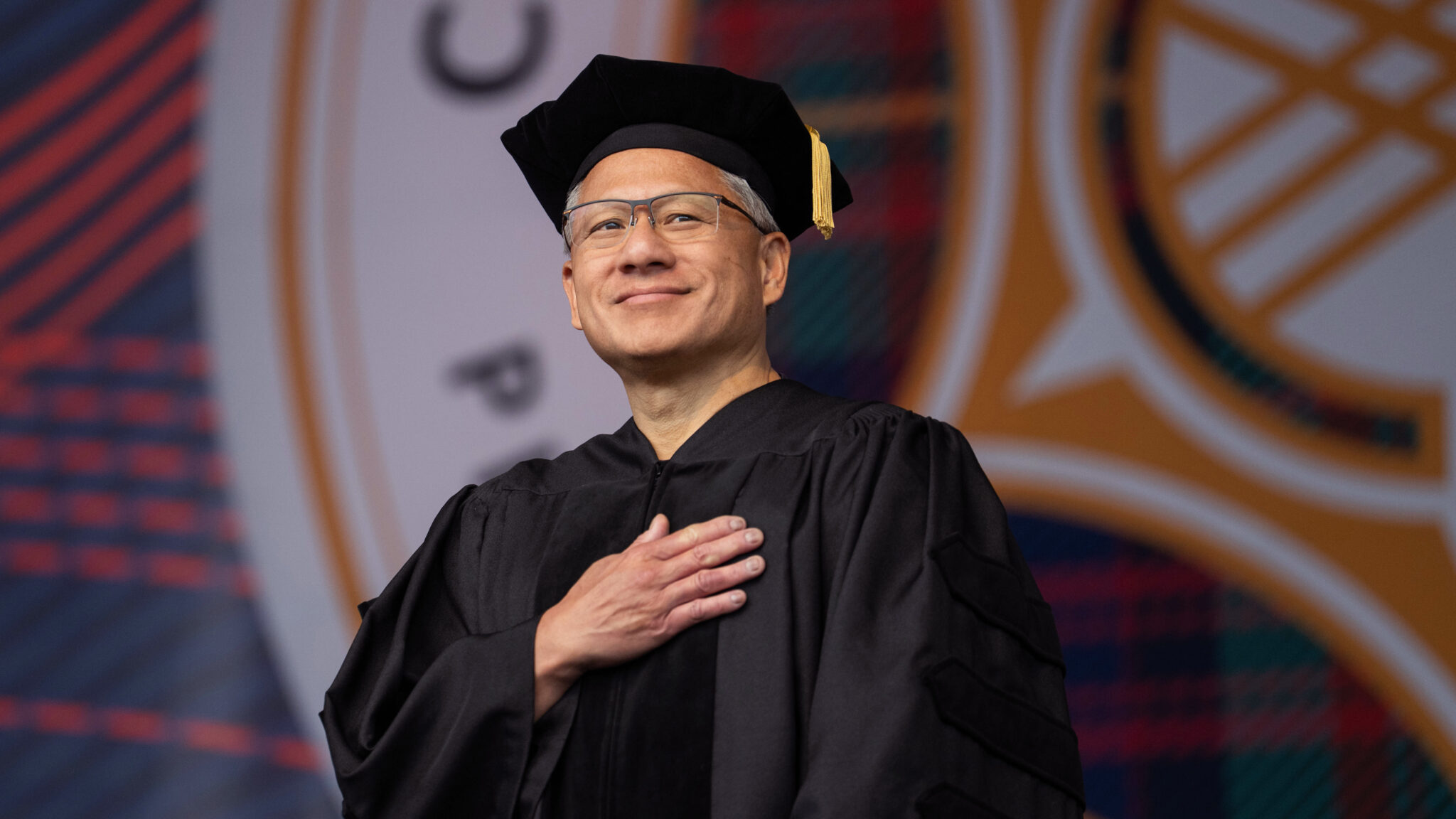
Jensen Huang delivered a commencement address at Carnegie Mellon University that positions artificial intelligence not as a niche technology but as the next foundational platform shift comparable to personal computers, the internet, and cloud computing. The NVIDIA CEO framed the moment as a generational opportunity for graduates entering the workforce, arguing that the convergence of powerful AI tools with accessible infrastructure creates an unprecedented starting point for new builders. This framing—echoed across the tech industry's leadership ranks—serves as both genuine optimism and a strategic narrative designed to attract talent and capital into an ecosystem where NVIDIA holds disproportionate leverage. The speech's centerpiece emphasized that intelligence itself has become the commodity, with intelligence-as-infrastructure now democratizing access to capabilities once reserved for the largest institutions.
The timing and context matter enormously here. Huang's career literally began when the PC revolution was crystallizing in the 1980s, and his company emerged from that platform shift to become one of the most valuable technology enterprises in history. Now, with GPU-driven AI workloads dominating semiconductor demand and NVIDIA commanding roughly 80-90% of the AI inference and training chip market, he occupies a position from which he can credibly claim insider knowledge about platform transitions. His invocation of this parallel—graduating at the start of the PC era versus graduates today starting in the AI era—is not coincidental rhetorically. It's designed to convey that the next generation of fortunes will be built on AI infrastructure, just as they were on computing platforms before. The speech arrives at a moment when enterprise adoption of generative AI is accelerating, regulatory frameworks are crystallizing, and the once-speculative promises of AI are beginning to manifest in measurable business outcomes.
The deeper implication of Huang's argument is that a technology shift of this magnitude forces every industry to restructure around new capabilities and modes of operation. If intelligence becomes a utility—deployable across healthcare, manufacturing, education, finance, and infrastructure—then competitive advantage accrues to those who master the integration of AI into existing workflows. This is a wholesale reinvention cycle, not a marginal upgrade. The claim about "reindustrializing America" deserves scrutiny, but it reflects a genuine belief in Silicon Valley that AI infrastructure represents a rare opportunity to reverse decades of offshoring and rebuild domestic manufacturing and technical capacity. Whether that materializes depends on government policy, capital allocation, and supply chain dynamics—none of which Huang directly controls, but all of which NVIDIA's dominance influences.
The constituencies affected by this shift span far wider than software engineers or AI researchers. Huang explicitly mentioned electricians, plumbers, ironworkers, and technicians—workers whose productivity could accelerate or whose roles could transform through AI-assisted tools. This democratization narrative matters because it signals that platform transitions are not purely elite phenomena. The real test of his claim lies in whether AI tooling becomes cheap and simple enough for skilled trades and small enterprises to adopt, or whether it remains gated behind expensive infrastructure and expertise. Developers, certainly, face an immediate shift in how they work, what they build, and where value creation occurs. Enterprise IT leaders must now architect for AI-native systems rather than retrofitting AI into legacy stacks. Researchers have access to exponentially more compute than five years ago, collapsing barriers to experimentation.
Competitively, Huang's commencement rhetoric reveals NVIDIA's strategic confidence but also vulnerability. The company's dominance in AI chips appears unassailable in the near term, but the speech's emphasis on democratization and opportunity carries embedded risk. If AI becomes genuinely commodified—if margin-compressed AI chips proliferate, or if custom silicon from cloud providers erodes NVIDIA's advantages—the narrative of universal opportunity could flip into one of margin compression and overcapacity. The geopolitical angle, too, lurks beneath the surface. NVIDIA's own supply chain and export restrictions signal that AI infrastructure buildout is not universal—it's conditional on trade relationships and government policy. The optimistic "era of reindustrialization" depends on America successfully competing for AI dominance against China, a competition now shaped as much by policy as by engineering.
What follows from this moment is worth watching closely. Will the promised accessibility materialize—will small enterprises genuinely democratize AI, or will it concentrate further in the hands of the few with capital and expertise? Can America actually rebuild manufacturing and technical depth, or is the reindustrialization narrative political cover for capital seeking AI-adjacent sectors? And critically, will the governance structures and safety considerations keep pace with deployment velocity, or will the next few years see a race-to-the-bottom dynamic where implementation outpaces oversight? Huang's speech positions his company and the industry optimistically. The harder question is whether that optimism survives contact with reality.
This article was originally published on NVIDIA AI Blog. Read the full piece at the source.
Read full article on NVIDIA AI Blog →DeepTrendLab curates AI news from 50+ sources. All original content and rights belong to NVIDIA AI Blog. DeepTrendLab's analysis is independently written and does not represent the views of the original publisher.