Analytics Vidhya
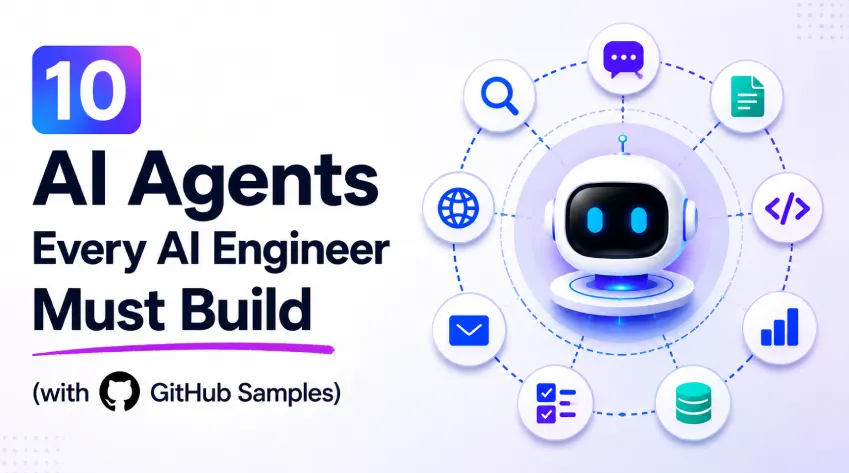
Analytics Vidhya has published a curated list of ten agent architectures positioned as essential builds for engineers seeking practical experience with AI systems. The selection spans recommendation systems, code navigation agents, research automation, browser control, document retrieval, and customer support automation, each paired with open-source GitHub reference implementations. The framing is instructional—these are patterns to learn by building—but the underlying signal is more structural: the field is converging on a specific set of canonical agent designs that are now considered baseline competency for AI engineers entering the market.
The timing reflects a fundamental shift in what "AI engineering" means in 2026. Large language models have become commodity infrastructure; the differentiation now lies in orchestration—designing systems that chain multiple tool calls, maintain memory across interactions, handle failures gracefully, and decompose complex tasks into solvable steps. The agents highlighted in this list aren't novel research contributions; they're pragmatic applications of existing models wrapped in structured workflows. This transition from "can we build a chatbot" to "how do we build a system that actually executes real work" marks the maturation of the field from research-driven to engineering-driven, where the bottleneck shifts from model capability to architectural clarity.
What matters about this article is less the specific agents and more what their selection implies about the market's assessment of critical capabilities. The absence of training-focused projects or model fine-tuning work is conspicuous—the implication is that hands-on AI engineering competency no longer centers on understanding how models learn, but rather on how to deploy existing models effectively. This represents a significant professionalization of the AI engineering role, similar to how backend engineering matured away from databases and toward distributed systems and reliability. It also signals that the bar for entry is shifting: new engineers no longer need to understand transformer architecture to be valuable; they need to understand prompt design, tool integration, and failure modes in production systems.
The practical impact falls directly on junior and mid-career engineers trying to position themselves in the AI market. These reference implementations serve as both learning resources and implicit job qualifications—companies hiring for agent development roles are likely to expect candidates to have hands-on experience with at least a few of these patterns. For career-focused engineers, the message is clear: understanding how to build a recommendation agent, a RAG system, or a browser automation agent is now part of baseline technical fluency, similar to how understanding REST APIs and basic databases became essential for web developers fifteen years ago. This commoditization of agent patterns accelerates the timeline for all practitioners to upskill on these specific architectures.
Competitively, this listicle reveals something important about platform dynamics. Anthropic, with Claude Code offering integrated agent development, and GitHub, with Copilot's embedded reasoning, have structural advantages because engineers who learn on their platforms will naturally standardize on their APIs and architectural assumptions. Open-source reference implementations democratize the knowledge, but they don't eliminate the lock-in effect of early familiarity. Companies investing in proprietary agentic frameworks are betting that once developers internalize a specific orchestration pattern—whether it's Claude's tool-use model, OpenAI's function calling, or Google's agentic reasoning—they'll continue using that approach because switching costs are high.
The open question is whether these ten patterns will remain stable targets or become obsolete as models improve. If frontier models gain substantially better reasoning and planning capabilities in the next year or two, the manual scaffolding required to build some of these agents—particularly research agents and document Q&A systems—might collapse into simpler prompts. Conversely, if model capabilities plateau, these patterns could calcify as industry standards for decades. The article's confidence in publishing GitHub samples implies the authors believe these are durable, but the pace of AI progress suggests architects should plan for these patterns to have a relatively short shelf life before the next generation of tooling renders them partially obsolete.
This article was originally published on Analytics Vidhya. Read the full piece at the source.
Read full article on Analytics Vidhya →DeepTrendLab curates AI news from 50+ sources. All original content and rights belong to Analytics Vidhya. DeepTrendLab's analysis is independently written and does not represent the views of the original publisher.