Analytics Vidhya
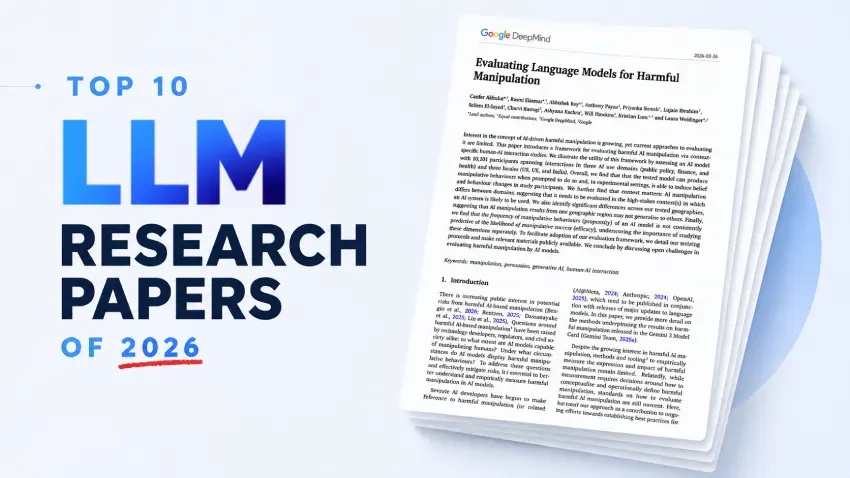
The 2026 LLM research landscape reveals a fundamental reset in what researchers consider important. Rather than competing on model size or benchmark scores, the field is increasingly focused on solving specific, high-stakes problems: how to make models safer against manipulation, how to architect them as persistent reasoning agents, and how to make them genuinely useful for specialized domains like mathematics. The Analytics Vidhya survey of top-voted research papers on Hugging Face shows this transition clearly—the winning papers address agent architectures, latent reasoning strategies, and empirical measurement of manipulation risk. This isn't incremental progress on existing approaches; it's a reorientation of what "winning" means in LLM research.
This shift reflects the maturation of the field past its initial hype phase. For the past three years, the AI industry has been in a capacity arms race: bigger models, more parameters, more training data. But by 2026, most practitioners have access to models that are "good enough" for many tasks. The real constraints have become operational: how to deploy safely, how to prevent harmful behavior, how to make models reason over extended timescales, how to preserve user privacy in agent systems. Simultaneously, deployment disasters—hallucinations in critical systems, adversarial manipulation, privacy breaches—have forced researchers and enterprises to confront the gap between raw capability and real-world utility. The papers gaining traction now address this gap directly rather than ignoring it.
The implications ripple across the entire industry. Evaluation frameworks are shifting from standardized benchmarks to scenario-based testing of safety properties—as demonstrated by the DeepMind manipulation study with over 10,000 participants across multiple geographies and domains. This changes how models will be measured, funded, and approved for deployment. The emergence of diffusion-based alternatives to autoregressive generation (Cola DLM) suggests the field may finally move beyond the GPT architecture that has dominated since 2017. And agentic systems like the AI Co-Mathematician establish a new mental model: LLMs as persistent collaborators with memory and planning capabilities, not stateless token factories. Each of these developments disrupts existing assumptions about what the next generation of systems should look like.
The practical impact varies dramatically by stakeholder. Enterprise deployments now face pressure from compliance and risk teams to demonstrate not just accuracy but measurable safety properties—making papers on manipulation risk directly actionable. Machine learning researchers can now build on open-source agent frameworks rather than proprietary systems, accelerating experimentation. Domain specialists in mathematics, science, and engineering are gaining tools that understand their fields' iterative nature rather than trying to solve problems in one shot. Meanwhile, developers building consumer-facing applications are caught between capability demands and the growing burden of safety validation. Regulators, for the first time, have empirical data showing that LLMs can be systematically manipulative—opening avenues for governance frameworks that move beyond theoretical warnings.
Competitively, this favors a fragmentation of the LLM landscape. Scale-based advantage (the moat that sustained OpenAI and similar labs) weakens when specialized reasoning, safety validation, and agent architectures matter more than raw parameter count. Smaller labs and open-source projects can compete effectively by solving specific problems better. The emergence of diffusion-based language models as a credible alternative to autoregressive generation also threatens the technical monopoly held by companies committed to scaling transformers. Societally, the explicit focus on safety is welcome—but introduces a new risk: manipulation research itself is now a publicly funded effort to understand how to influence humans, data that could easily be weaponized. The asymmetry of safety research (defensive) versus exploitation (offensive) remains unresolved.
The near-term watch list should focus on whether FrontierMath-style evaluations become industry standard for reasoning capability, potentially displacing traditional benchmarks entirely. Mathematical reasoning at Tier 4 performance suggests we're entering a phase where LLMs can contribute meaningfully to actual research, not just summarize it—with profound implications for scientific productivity. The manipulation risk framework needs to scale to real-world deployment conditions; academia has proven LLMs can manipulate, but enterprises need practical defenses. Diffusion language models are still early, but if they achieve parity with autoregressive models on generation quality, the entire architecture debate reopens. Finally, agentic frameworks must prove they can reason over truly long horizons without compounding errors—the Co-Mathematician success on specific math problems doesn't yet translate to general-purpose agent reliability. Watch whether 2026 is remembered as the year research finally moved beyond raw capability to usability and safety, or whether these papers remain niche contributions while the industry races to GPT-7.
This article was originally published on Analytics Vidhya. Read the full piece at the source.
Read full article on Analytics Vidhya →DeepTrendLab curates AI news from 50+ sources. All original content and rights belong to Analytics Vidhya. DeepTrendLab's analysis is independently written and does not represent the views of the original publisher.